

Tanaka Petty Aogami #2 Damascus 150mm (5.9")
Tanaka Petty Aogami #2 Damascus 150mm (5.9") is an exceptional option for chefs and hobby cooks in search of a hand-forged Japanese knife crafted from traditional steel. It sports a traditional Japanese aesthetic both in terms of its handle and the minimalist damascus finish on the blade. Its size offers versatile use on and off the cutting board, and it nicely complements larger knives.
The superior Aogami #2 steel ensures long-lasting sharpness and easy sharpening. It's worth noting that proper maintenance is essential for this blade, as it develops a natural protective patina over time.
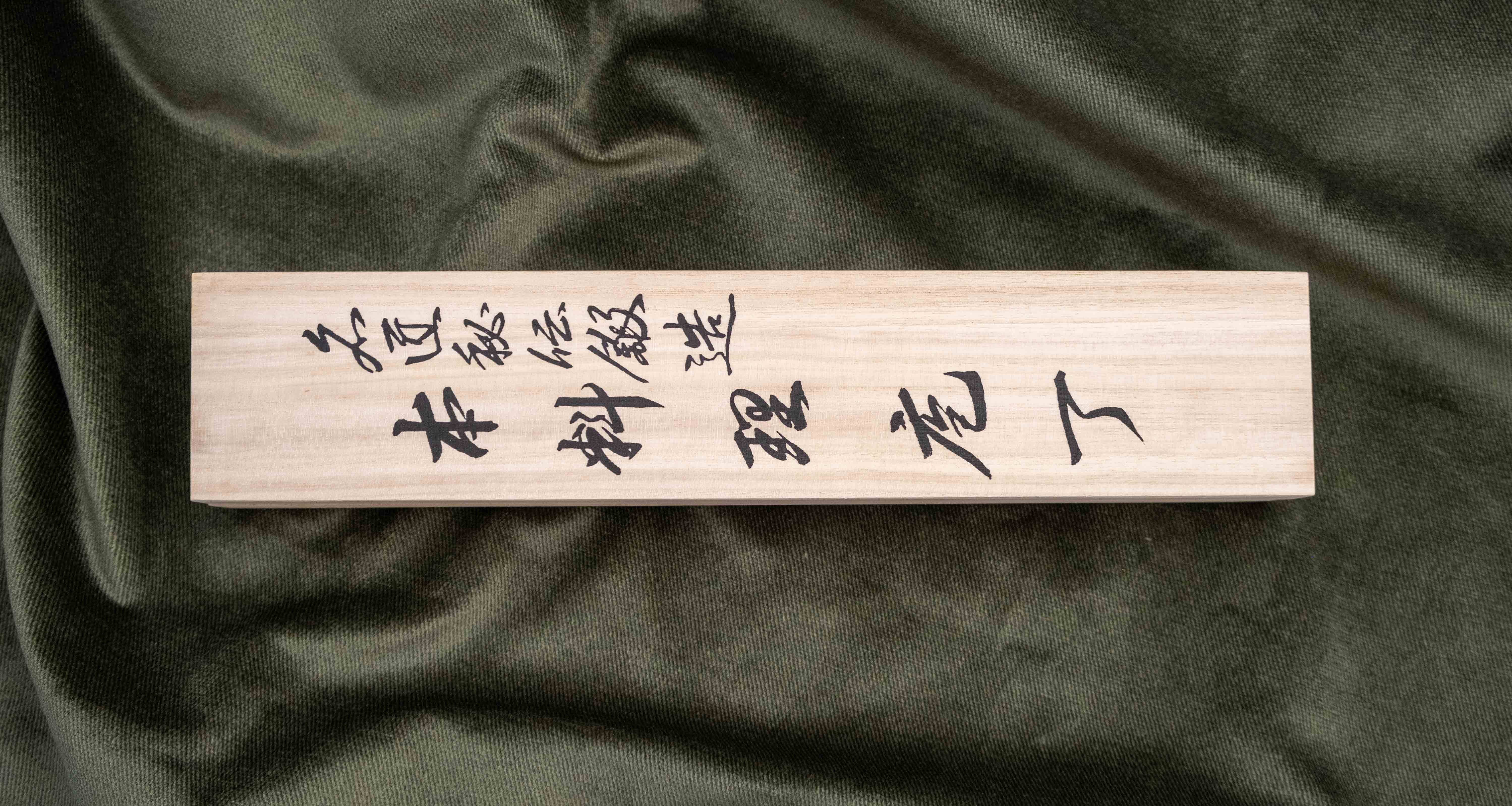
The minimalistic, lightweight petty was forged by the famous Shigeki Tanaka. It comes in a traditional Japanese paulownia wooden box adorned with black Japanese kanji and makes a truly special gift.
Due to the asymmetry of the handle, the knife is suitable for right-handed people.
BLADE SHAPE:
Petty knives are designed for smaller tasks on and off the cutting board. It's an indispensable knife in any kitchen and can be used for peeling, mincing, paring, and decorating food. Petty or utility knives are basically a smaller version of gyuto or chef's knives. Due to the length of the blade, it can also be used as a stand-alone knife if you are uncomfortable with longer blades. A must-have knife in every kitchen!
Use for: peeling, trimming, garnishing, carving, chopping herbs, chopping garlic, slicing small pieces of dried meat, trimming meat, filleting small portions of fish, and similar tasks.
STEEL:
Aogami #2 steel is a very popular steel in Japanese knife making and one of the finest high-carbon steels, meaning the knives forged from it will have excellent edge retention and also sharpen very easily. At the same time, it is less resistant to corrosion, meaning the blade can develop a patina, while longer exposure to water or other corrosives could also lead to rusting. This is improved to some extent with the addition of chromium and tungsten, but it’s still a high-carbon steel that should be maintained accordingly. Aogami #2 steel is composed of carbon (C) 1.1%, chromium (Cr) 0.5%, manganese (Mn) 0.3%, and tungsten (W) 1.5%.
|
🚩 Advantages of Aogami #2 steel are a very fine, gentle sharpness - it is easy to sharpen, and remains sharp for a long time. The lower part of the blade where the high carbon steel is exposed will develop some patina after time, so we recommend oiling the blade regularly in order to prevent the development of rust. Read more about how to take care of high carbon knives and patina in our Knife maintenance blog post. |
LAMINATION:
The core of the blade is clad in two layers of softer steel (this type of blade construction is called san mai; for more read Blade Construction: Lamination). This is a great combination of two different types of steel - the softer outer layers will improve the blade's flexibility and toughness, while the top-notch steel of the cutting edge will slice through food easily.
GEOMETRY:
The knife has a double-bevel blade (symmetrical) and has a v-edge grind.
The knife narrows towards the tip. It is heavier and stronger at the handle and thinner and more precise at the tip. This blade shape makes the knife easier to use because it is very responsive, easily maneuverable, and nicely balanced. The heel of the blade provides increased leverage, while the tip enables precise cutting. This type of blade design is called distal taper - you can read more about it in the article on blade geometry.
BLADE FINISH:
The blade has a minimalist damascus finish (see article Blade Construction: Blade Finish for more) with a hand-chiseled kanji carrying the signature of master blacksmith Shigeki Tanaka: 名匠誠貴作 "Made By Master Craftsman Shigeki"
HANDLE:
This knife was fitted with a D-Shaped traditional Japanese wooden handle, made of magnolia wood with a buffalo horn ferrule. Due to its asymmetry, the blade is only suitable for right-handed people.
ABOUT THE SMITHY:
The remarkable performance of kitchen knives may well be a synonym for Shigeki Tanaka. This young skilled craftsman who can boast with his radical design and mastery makes knives that are beloved by people all over the world. Shigeki Tanaka is the fourth-generation blacksmith. Due to his excellent knife-making skills, Shigeki Tanaka is one of the most recognizable blacksmiths in the city of Miki, Japan.
Product Information
Product Information
Shipping & Returns
Shipping & Returns
Description
Tanaka Petty Aogami #2 Damascus 150mm (5.9") is an exceptional option for chefs and hobby cooks in search of a hand-forged Japanese knife crafted from traditional steel. It sports a traditional Japanese aesthetic both in terms of its handle and the minimalist damascus finish on the blade. Its size offers versatile use on and off the cutting board, and it nicely complements larger knives.
The superior Aogami #2 steel ensures long-lasting sharpness and easy sharpening. It's worth noting that proper maintenance is essential for this blade, as it develops a natural protective patina over time.
The minimalistic, lightweight petty was forged by the famous Shigeki Tanaka. It comes in a traditional Japanese paulownia wooden box adorned with black Japanese kanji and makes a truly special gift.
Due to the asymmetry of the handle, the knife is suitable for right-handed people.
BLADE SHAPE:
Petty knives are designed for smaller tasks on and off the cutting board. It's an indispensable knife in any kitchen and can be used for peeling, mincing, paring, and decorating food. Petty or utility knives are basically a smaller version of gyuto or chef's knives. Due to the length of the blade, it can also be used as a stand-alone knife if you are uncomfortable with longer blades. A must-have knife in every kitchen!
Use for: peeling, trimming, garnishing, carving, chopping herbs, chopping garlic, slicing small pieces of dried meat, trimming meat, filleting small portions of fish, and similar tasks.
STEEL:
Aogami #2 steel is a very popular steel in Japanese knife making and one of the finest high-carbon steels, meaning the knives forged from it will have excellent edge retention and also sharpen very easily. At the same time, it is less resistant to corrosion, meaning the blade can develop a patina, while longer exposure to water or other corrosives could also lead to rusting. This is improved to some extent with the addition of chromium and tungsten, but it’s still a high-carbon steel that should be maintained accordingly. Aogami #2 steel is composed of carbon (C) 1.1%, chromium (Cr) 0.5%, manganese (Mn) 0.3%, and tungsten (W) 1.5%.
|
🚩 Advantages of Aogami #2 steel are a very fine, gentle sharpness - it is easy to sharpen, and remains sharp for a long time. The lower part of the blade where the high carbon steel is exposed will develop some patina after time, so we recommend oiling the blade regularly in order to prevent the development of rust. Read more about how to take care of high carbon knives and patina in our Knife maintenance blog post. |
LAMINATION:
The core of the blade is clad in two layers of softer steel (this type of blade construction is called san mai; for more read Blade Construction: Lamination). This is a great combination of two different types of steel - the softer outer layers will improve the blade's flexibility and toughness, while the top-notch steel of the cutting edge will slice through food easily.
GEOMETRY:
The knife has a double-bevel blade (symmetrical) and has a v-edge grind.
The knife narrows towards the tip. It is heavier and stronger at the handle and thinner and more precise at the tip. This blade shape makes the knife easier to use because it is very responsive, easily maneuverable, and nicely balanced. The heel of the blade provides increased leverage, while the tip enables precise cutting. This type of blade design is called distal taper - you can read more about it in the article on blade geometry.
BLADE FINISH:
The blade has a minimalist damascus finish (see article Blade Construction: Blade Finish for more) with a hand-chiseled kanji carrying the signature of master blacksmith Shigeki Tanaka: 名匠誠貴作 "Made By Master Craftsman Shigeki"
HANDLE:
This knife was fitted with a D-Shaped traditional Japanese wooden handle, made of magnolia wood with a buffalo horn ferrule. Due to its asymmetry, the blade is only suitable for right-handed people.
ABOUT THE SMITHY:
The remarkable performance of kitchen knives may well be a synonym for Shigeki Tanaka. This young skilled craftsman who can boast with his radical design and mastery makes knives that are beloved by people all over the world. Shigeki Tanaka is the fourth-generation blacksmith. Due to his excellent knife-making skills, Shigeki Tanaka is one of the most recognizable blacksmiths in the city of Miki, Japan.